

Prefer to listen? This article is also an episode of the Bipolar Clarity Podcast.Listen to episode 23 →
Educational content — not medical advice. Nothing here is a reason to start, stop or change a medication on your own. That conversation belongs with your prescriber.
The essentials in 30 seconds
- The urge after a diagnosis is to fix everything by midnight. Trying to change everything at once is the fastest way to crash, because your brain is already doing a large adjustment.
- Set anchors, not goals. A goal runs on willpower and executive function, and both are in short supply right now. An anchor is the weight that stops a ship drifting in a storm.
- Three anchors: a fixed wake time, a one-minute wind-down cue, and a five-minute daily check-in. That’s the whole system.
- Drop them into four weeks — Stabilize, Observe, Adjust, Reinforce — and add one small tool a week rather than ten on day one.
- Around week two you may feel bored and flat. Most people misread that as a warning sign. It is usually the first quiet week in years.
- The tracker measures consistency, not mood. Did you do the ritual? Tick.
Why anchors beat goals in the first month
A goal is something you achieve. Lose ten pounds. Read four books. Goals run on willpower and executive function, and right after a diagnosis those are exactly the two things you have least of.
An anchor is different. It is the heavy weight that stops a ship drifting while the weather does what it likes. The ship still moves. It just doesn’t end up on the rocks.
That distinction matters because bipolar disorder is closely tied to rhythm. Your internal clock — the pacemaker for sleep and energy — is more fragile than most people’s, and when it gets knocked over, mood follows it down. Which leads to the sentence worth writing on the inside of a cupboard door: you cannot willpower your mood steady, because mood rides on rhythm.
The three anchors don’t try to force your mood. They reset the rhythm underneath it, and they tell the oldest part of your brain something simple: we know what time it is, and we’re safe.
Anchor one: the wake time
Notice this is not bedtime. You can’t order yourself to fall asleep, and trying mostly manufactures sleep anxiety.
You can order yourself to get up.
Pick one time — say seven thirty — and for thirty days the alarm goes off at seven thirty. Every day. Saturdays included. Short night or long one. (After a very short night, safety comes first: don’t drive drowsy. And if short nights keep repeating, or you’re sleeping little without feeling tired, call your care team.) The moment light hits your eyes, a roughly sixteen-hour timer starts running toward tonight’s melatonin. Anchor the morning and you stabilise the night without touching the night.
Anchor two: the one-minute wind-down cue
Not a two-hour ritual of yoga and journalling and herbal tea. That is impossible to sustain when you’re depressed, and abandoning it becomes one more piece of evidence against yourself.
One minute. The same tiny sequence, in the same order, every night: phone onto the kitchen charger, one lamp on and the overheads off, wash your face. It is a Pavlovian bell. You are not relaxing yourself; you are telling your brain the day is closed.
Anchor three: the five-minute check-in
Not a diary. A dashboard read.
Once a day — lunchtime works well — three questions. How many hours did I sleep? Is my energy low, steady or buzzy? What is one thing I can do to stay steady today?
“Six hours. Buzzy. Switch to decaf.” Done. You’re not psychoanalysing yourself. You’re reading the gauges.
The four-week roadmap
Week one — stabilize. Your only job is to hit the anchors. Don’t quit sugar, don’t start running, don’t fix your relationships. Wake, cue, check-in. It will feel boring, and that is the point: bipolar disorder is chaotic, so the treatment should be dull. Miss a day and you have not broken a streak. You’re a person learning a skill. Do the next anchor.
Week two — observe. Anchors are set, so switch on detective mode and watch for drift. Talking faster than usual? Making more plans than you can keep? Craving carbohydrates? You are looking for clusters — one odd day is just an odd day, but a few days of short sleep plus high energy is a cluster, and a cluster is data. (One exception: sleeping much less without feeling tired, even for a night or two, is a reason to call your care team now, not later.) Otherwise, don’t fix anything yet. Write it down: “racing thoughts, 3pm.” Naming it separates you from it.
Week three — adjust. Now act on the data, and add one tool: the landing pad. A tray by the door where keys, wallet and morning meds live. Hunting for your keys spikes cortisol at seven in the morning, and a cortisol spike that early can tilt the whole day. The landing pad lowers the friction around your wake anchor and protects it. Then look at your inputs: if week two said “buzzy” every afternoon, try no coffee after noon and watch the data move.
Week four — reinforce. Three weeks of data, and you’re still here. Now add the external hard drive: one person. “I’m working on a steady wake-up time for my mood. If I text you ‘good morning’ at eight, can you just send back a thumbs up?” Not a therapist. A witness. Knowing somebody is waiting for that message makes getting out of bed easier than any amount of resolve.

“I missed my wake time by an hour, I’ve ruined it”
Kill this one before it derails you, because it ends more thirty-day attempts than any symptom does.
Your rhythm is not brittle. It is flexible — it simply prefers consistency. Oversleep and you have not undone anything. Do light loading instead of spiralling: get outside immediately, ten minutes of daylight instead of two, or a cold shower. You can tell your brain “it’s morning” manually, even when you’re late. The day is recoverable.
No overwhelm, no spam — just one small, practical tool to help you feel steadier. Free.
Subscribe — it's freeWhen boredom means peace
Here is the strange feeling, and it usually lands somewhere in week two.
As the anchors take hold you may suddenly feel bored. Flat. Vaguely empty, as though somebody turned the colour down. And this is a genuine danger zone, because a brain used to the adrenaline of chaos will sometimes go looking for drama to feel something again — pick a fight, spend money, blow up the schedule at eleven at night.
So reframe it now, before it arrives. That boredom is not emptiness. It is peace. It is the sound of an engine idling smoothly, possibly for the first time in years. Stability is quiet by design, and quiet feels wrong for a while before it starts feeling like relief.
Red-flag days: the anchors as a safety net
And what about the morning in week three when you wake pinned to the bed by leaden depression — or vibrating, wide awake, ready to buy a plane ticket?
The anchors hold, with one adjustment each.
- If you’re depressed, the wake time is the anchor to hold. Even if all you manage is the bed to the sofa, you get up and you get light.
- If you’re speeding up, the wind-down is the anchor to hold. Even if you aren’t tired: lights off, inputs down, screens away — and tell your care team you’re speeding up.
The anchors don’t cure an episode. They contain it. They stop it spiralling while you get help.
And if the agitation comes with dark thoughts — the crawling out of my skin feeling alongside them — please take it seriously and don’t sit with it alone. In the United States and Canada you can call or text 988 for the Suicide & Crisis Lifeline, or 911 in an emergency; our crisis page lists lines by country. Put the number in your phone tonight, while nothing is wrong. The worst moment is the wrong moment to start searching.
The tracker measures consistency, not mood
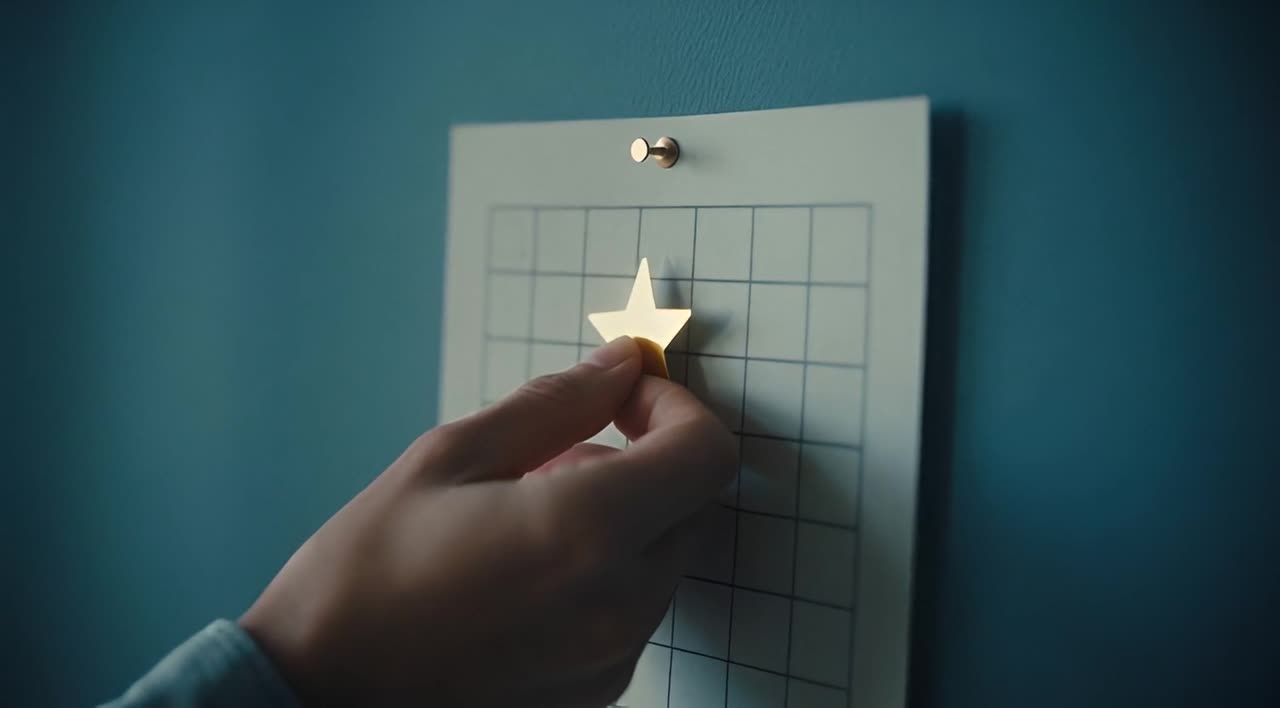
One page. Thirty boxes. Your wake time written at the top, your wind-down cue underneath it.
You are not scoring how you felt. Feelings are the weather, and grading yourself on the weather is how tracking turns into another way to fail. You are tracking whether you did the ritual. Did you get up at the time? Tick. Did you do the one-minute cue? Tick.
After seven days, give yourself a gold dot. An actual sticker, or a big star drawn in pen. It sounds childish and it works anyway, because visible proof of your own consistency releases dopamine, and you are rewarding stability rather than happiness.
Free 30-Day Anchor Sheet (PDF) — the one-page tracker from the video: your wake time, your wind-down cue, and thirty boxes. No email, no account.
Your homework, right now
Decide your wake time. Set the alarm. Move the phone charger across the room so you have to stand up to turn it off.
That’s it. Day one has started.
Because you do not have to solve the rest of your life today. You only have to solve tomorrow morning. And when you control the morning, you stop being a passenger of the diagnosis and start being the pilot.
Small anchors hold big ships.
Sources
- National Institute of Mental Health — Bipolar Disorder
- Depression and Bipolar Support Alliance (DBSA)
- MedlinePlus — Bipolar Disorder
- Ellen Frank — Interpersonal and Social Rhythm Therapy (IPSRT) / social rhythm theory
If you’re in crisis or thinking about harming yourself, you’re not alone and help is available right now. In the US & Canada call or text 988. In the UK & Ireland call 116 123 (Samaritans). Elsewhere, contact your local emergency services — Get Help Now lists lines by country.